Wednesday, October 30, 2013

Observation

Date: 29 October, 2013
Time: 7:00 - 9:00 PM X2=(4 hrs)
Place: Casey Key near Fish house
Sky Conditions: Partly cloudy
Instruments Used: Naked eye, binnoculars, Mr. Percival's Telescope
Planets: Venus
Bright Stars: Vega, Altair, Deneb, Polaris
ations Noted: Delphinus, Vulpecula, Sagitta, Grus, Sagittarius, Aquila, Aquarius, Capricorn, Lyra, Deneb, Scorpius,Pegasus, Hercules
Binary Stars:Alberio
Deep Sky Objects: M11, M27, M13
Other: the Moon, at least 5 satellites, at least 5 shooting stars, one blinking weather balloon? to the left of Delphinus, Milky Way

Alberio is a binary star. We observed it's two colors; a yellowish star and a bluish one. Observed Alberio and some of the deep sky objects in Mr. Percival's telescope. The galaxies appeared like fuzzy spots.

Friday, October 18, 2013

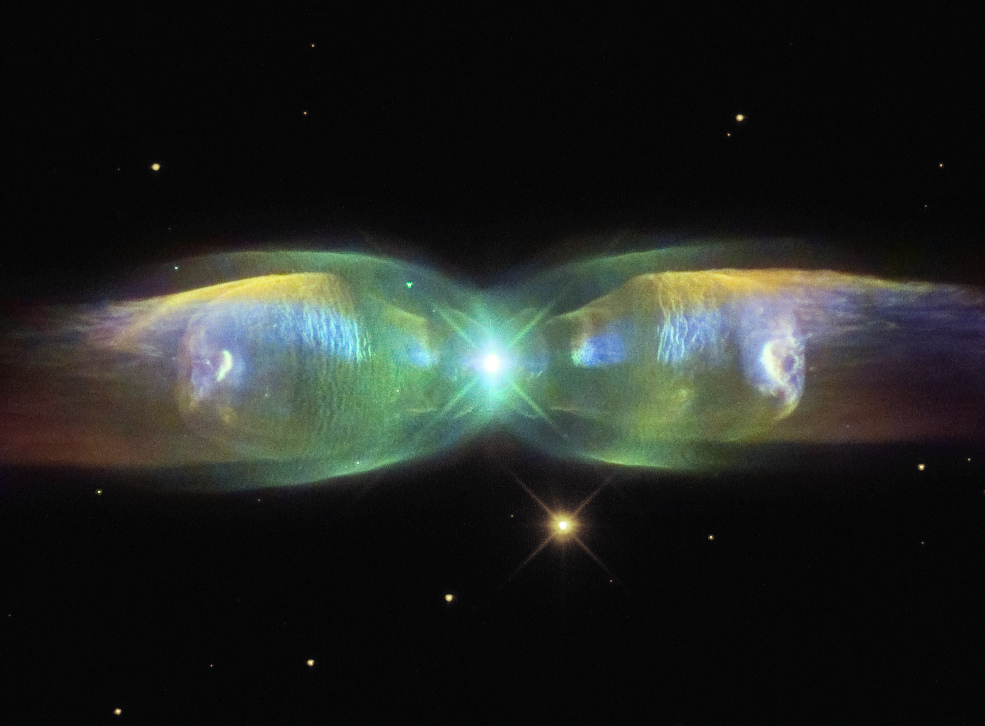
M2-9: Wings of a Butterfly Nebula

I selected the photograph from this link:
 
This star is transforming itself into a white dwarf by releasing gaseous envelopes. The expanded gas often forms a planetary nebula that fades over thousands of years. M2-9 is a butterfly planetary nebula 2100 light years away. In the center two stars orbit inside a gaseous disk. I find M2-9 really beautiful. The represented colors are really nice. I think that the shape of this planetary nebula is really awesome and it's interesting learning about why it forms and how.

See Explanation.  Clicking on the picture will download
 the highest resolution version available.

Thursday, October 17, 2013

Observation

Date: 17 October, 2013
Time: 9:00 - 10:00 PM
Place: Home (Sarasota)
Sky Conditions: Clear
Instruments Used: Naked eye
Planets: Venus
Bright Stars: Vega, Altair, Polaris, Thuban
Constellations Noted: Andromeda, Aquarius, Aquila, Cassiopeia, Cygnus, Cetus, Cepheus, Draco, Lyra, Pegasus, Hercules, Sagittarius, Scorpius, Serpens, Orion, Ursa Major, Ursa Minor
Binary Stars:
Deep Sky Objects:
Other: The Moon

The moon is close to full and Venus is so pretty. It was really nice out tonight. The sky was clear and I was able to star-hop easily (and study for the constellation quiz).

Wednesday, October 16, 2013

Observation

Date: 16 October, 2013
Time: 8:00 - 10:00 PM
Place: Home (Sarasota)
Sky Conditions: Mostly clear
Instruments Used: Naked eye
Planets: Venus
Bright Stars: Vega, Altair, Polaris, Thuban
Constellations Noted: Andromeda, Aquarius, Aquila, Cassiopeia, Cygnus, Cetus, Cepheus, Draco, Lyra, Pegasus, Hercules, Sagittarius, Scorpius, Serpens, Orion, Ursa Major, Ursa Minor
Binary Stars:
Deep Sky Objects:
Other: The Moon

I can now find certain stars easier and faster due to practice. I would like to learn more binary stars and maybe observe deep sky objects on one of the astronomy nights.

Willebrord Snell

Willebrord Snell was on born June 13th, 1580 in Leiden, Netherlands. He was a Dutch astronomer and mathematician. Snell's father, Rudolph Snell, was a professor of mathematics. Rudolph Snell wanted his son to study law, but Snell wished to follow in his father's footsteps and study mathematics. His father boarded students in his own house where he ran a private school. Snell grew up with the other students and was taught by his father. Later he traveled frequently, discussing astronomy. While in Prague he was introduced to Tycho Brahe and his assistant Johannes Kepler and assisted them in making observations. After Brahe died, Snell moved on to other locations and continued to visit mathematicians. Snell returned to Leiden and published many works including Eratosthenes Batavs, Cyclometricus, de Circuli dimensione, Tiphys Batavs, and Descriptio Cometae. In Cyclometricus he improved the method of calculating the approximate value of 'pi' by polygons. He also edited other works containing astronomical observation. Snell succeeded his father as professor of mathematics at University of Leiden when his father became too ill to continue teaching.  In 1615 he planned and carried a new method of finding the radius of the earth by determining the distance of one point on its surface from the parallel latitude of another, by means of triangulation. Snell rediscovered the law of refraction that was primarily discovered by Ibn Sahl. The law of refraction demonstrates that when a ray of light passes from a thinner element into a denser element the angle of the ray bends to the vertical. For many years Snell was thought to have been the founder of this law and was given credit. This is why the law of refraction often called "Snell's law". Snell received his degree for Master of Arts from the University of Leiden and married. It is rumored that he had eighteen children, of which, only three survived to adulthood. At age forty-six Snell died from colic. Symptoms of colic involve fever and paralysis of the arms and legs. He was ill for two weeks before passing on October 30th, 1626.


Works Cited
"Willebrord Snell." Biography. N.p., n.d. Web. 16 Oct. 2013. <http://www.thefamouspeople.com/profiles/willebrord-snell-528.php>.
"Willebrord Snellius." Wikipedia. Wikimedia Foundation, 24 Sept. 2013. Web. 16 Oct. 2013. <http://en.wikipedia.org/wiki/Willebrord_Snellius>.
"Willebrord Van Royen Snell." Snell Biography. N.p., n.d. Web. 16 Oct. 2013. <http://www-history.mcs.st-andrews.ac.uk/Biographies/Snell.html>.

Tuesday, October 15, 2013

Observation

Date: 15 October, 2013
Time: 8:00 - 10:00 PM
Place: Home (Sarasota)
Sky Conditions: Mostly clear
Instruments Used: Naked eye
Planets: Venus?
Bright Stars: Vega, Altair, Polaris, Thuban
Constellations Noted: Andromeda, Aquarius, Aquila, Cassiopeia, Cygnus, Cepheus, Draco, Lyra, Pegasus, Equuleus?, Hercules, Sagittarius, Scorpius, Serpens, Orion, Ursa Major, Ursa Minor
Binary Stars: Alberio
Deep Sky Objects:
Other: Milky Way?

Monday, October 14, 2013

Observation

Date: 14 October, 2013
Time: 8:00 - 10:00 PM
Place: Home (Sarasota)
Sky Conditions: Clear
Instruments Used: Naked eye
Planets: Venus
Bright Stars: Vega, Altair, Polaris, Thuban
Constellations Noted: Aquarius, Aquila, Cygnus, Cepheus,Corona Borealis, Corona Austalis, Draco, Lyra, Hercules, Sagittarius, Scorpius, Serpens, Orion, Ophiuchus, Ursa Major, Ursa Minor
Binary Stars: Alberio
Deep Sky Objects:
Other: Milky Way

It's easier now to find more constellations in the sky by using the star hopping methods from Star Lab.